About Our Lab
Explore the forefront of applied physics and optoelectronics research at our esteemed laboratory.
Our Mission
Bridging Fundamental Quantum Physics…
At the Semiconductor & Optoelectronics Laboratory, we explore and manipulate the extraordinary physical properties of low-dimensional quantum materials. We operate at the intersection of condensed matter physics and optoelectronic engineering—where broken symmetries and chiral interactions at the atomic scale can be harnessed for macroscopic technological breakthroughs.
Our approach combines rigorous physical inquiry with state-of-the-art experimental validation. We focus on polarization, chirality, and photo-induced transport as quantitative handles to understand emergent quantum phenomena.
By connecting fundamental mechanisms to device-relevant architectures, we aim to translate discovery into reliable and scalable optoelectronic platforms for future sensing, information processing, and energy technologies.
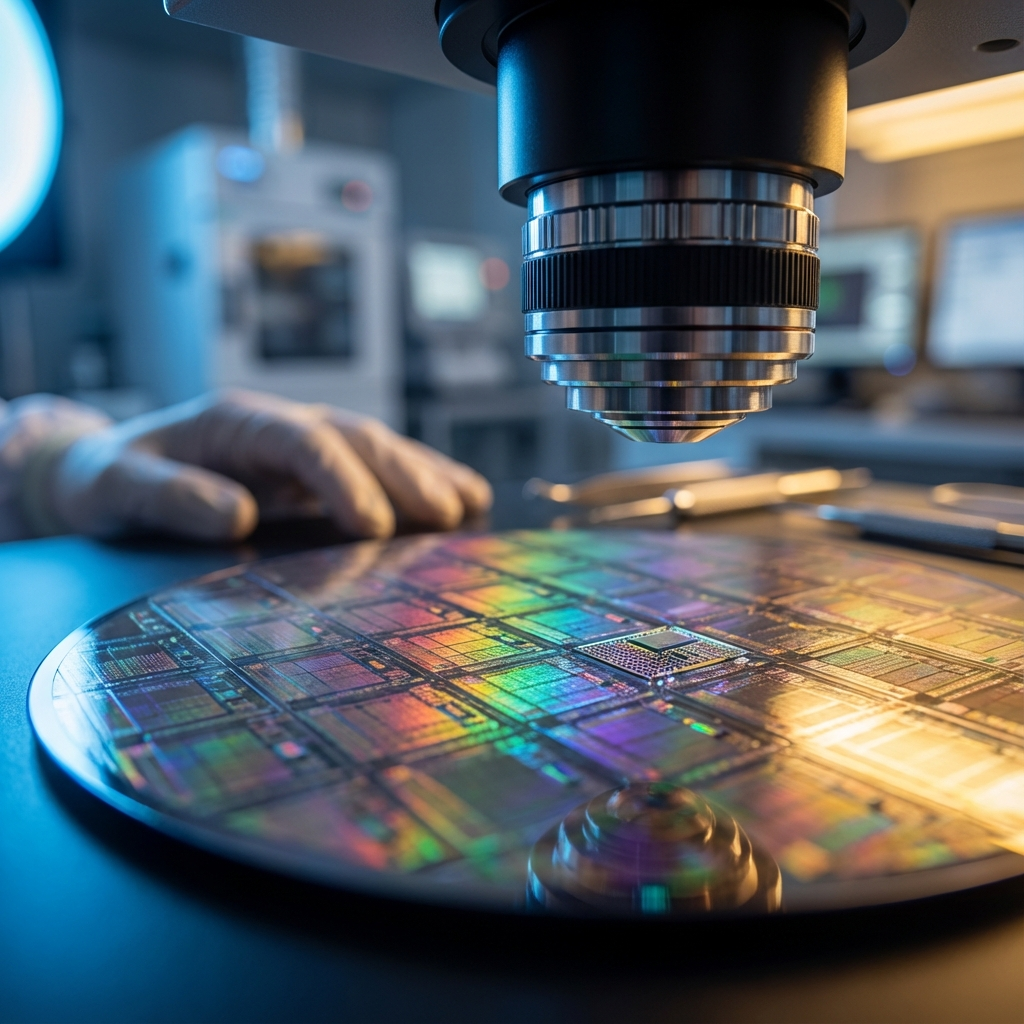
Polarization-resolved spectroscopy and device-level measurements on low-dimensional materials.
At a Glance
2D TMDs
Perovskites
Graphene & heterostructures
Weyl/topological semimetals
Research Pillars
Symmetry Breaking & Phase Transitions
We study how inversion asymmetry, stacking order, and moiré superlattices reshape electronic structures in van der Waals materials. Our focus includes topological crossovers and metal–insulator transitions that provide tunable quantum states.
Chiral Optics & Valleytronics
We exploit the coupling between circular polarization and the valley degree of freedom to control and read out quantum states in low-dimensional materials. Using helicity-resolved spectroscopy and photocurrent signatures such as CPGE, we build non-invasive routes toward low-power valleytronic functionalities.
Advanced Nanophotonics & Device Physics
Beyond discovery, we engineer materials and interfaces for device-relevant performance—covering quantum dots, nanowires, and 2D semiconductors. We develop workflows for defect and nanocrystal luminescence optimization and connect optical responses to device operation.
How We Work
Discover (Physics-first)
Identify symmetry/chirality-driven phenomena with quantitative polarization optics and spectroscopy.
Validate (Cross-check & calibrate)
Use control experiments, calibration routines, and device-level readouts to verify mechanisms and reduce ambiguity.
Translate (Device relevance)
Connect physical metrics (e.g., polarization, CPGE, transport signatures) to design rules for optoelectronic architectures.
facilities
Polarization-resolved spectroscopy
Helicity/linear polarization control & analysis across PL and scattering.
Momentum-space (k-space) imaging
Back-focal-plane imaging and angular emission analysis for optical selection rules.
Device-level optoelectronics
Photocurrent mapping, electrical characterization, and structure–property correlation.
Collaboration & Impact
We collaborate with researchers and industry partners to bridge fundamental discoveries and real-world constraints. Our goal is to provide reproducible measurement strategies and mechanism-based design principles that accelerate device concepts in sensing, information technologies, and photonics.
Join Our Lab
We welcome motivated students and collaborators interested in symmetry, chirality, and quantum optoelectronics. If you’re excited about building rigorous experiments and translating physics into devices, let’s talk.
Students
Undergraduate/Graduate projects and mentoring
Postdocs/Researchers
Co-leading new directions and instrumentation
Collaborators
Joint projects, shared facilities, and proposals