
FACILITIES

Advanced experimental platforms for chiral optics,
low-dimensional quantum materials, and optoelectronics.

CORE FACILITIES

Integrated measurement platforms supporting chiral photonics,
quantum materials, and optoelectronic devices.

optical spectorcopy

OPTICAL SPECTROSCOPY

We perform polarization-resolved optical spectroscopy to investigate excitonic resonances, phonon coupling, and light–matter interactions in low-dimensional quantum materials. Our platform enables systematic studies under controlled excitation conditions, revealing symmetry-dependent optical responses

Capabilities
• Polarization-resolved PL and Raman spectroscopy
• Temperature-dependent optical measurements
• Exciton–phonon interaction analysis
• Circular polarization and chiroptical response probing
k speca pl

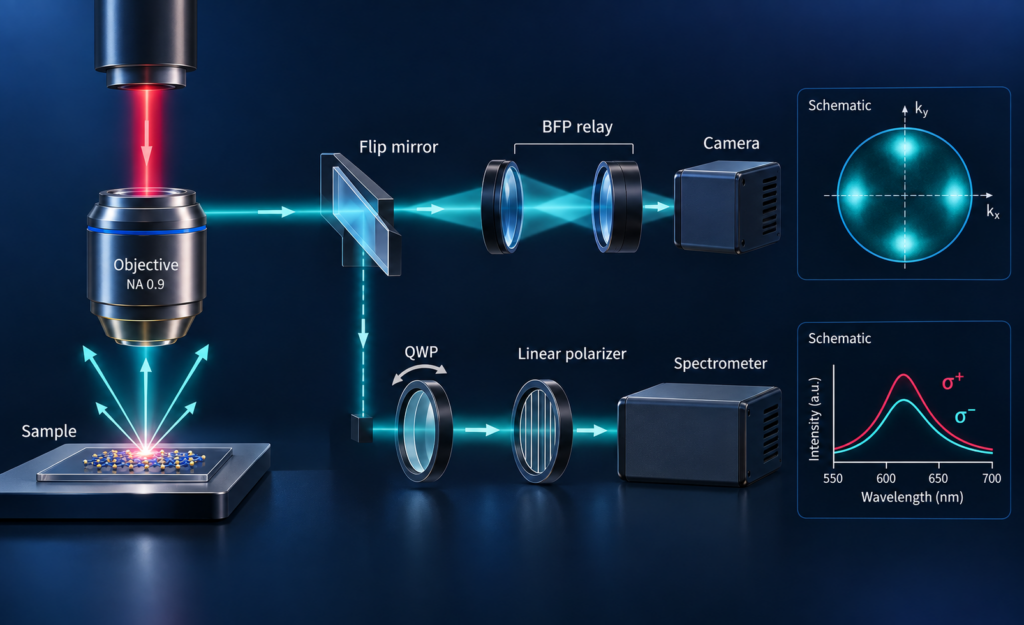
K-SPACE & CHIROPTICAL MEASUREMENTS

We conduct momentum-space (k-space) optical measurements and chiroptical spectroscopy to directly visualize angular emission patterns and symmetry breaking in quantum materials. These measurements provide direct access to valley polarization, circular dichroism, and chiral optical selection rules.

Capabilities
• k-space (BFP) photoluminescence imaging
• Circular dichroism and CPL measurements
• Valley polarization and angular emission analysis
• Symmetry-resolved optical characterization
device & transport measurements

DEVICE & TRANSPORT MEASUREMENTS

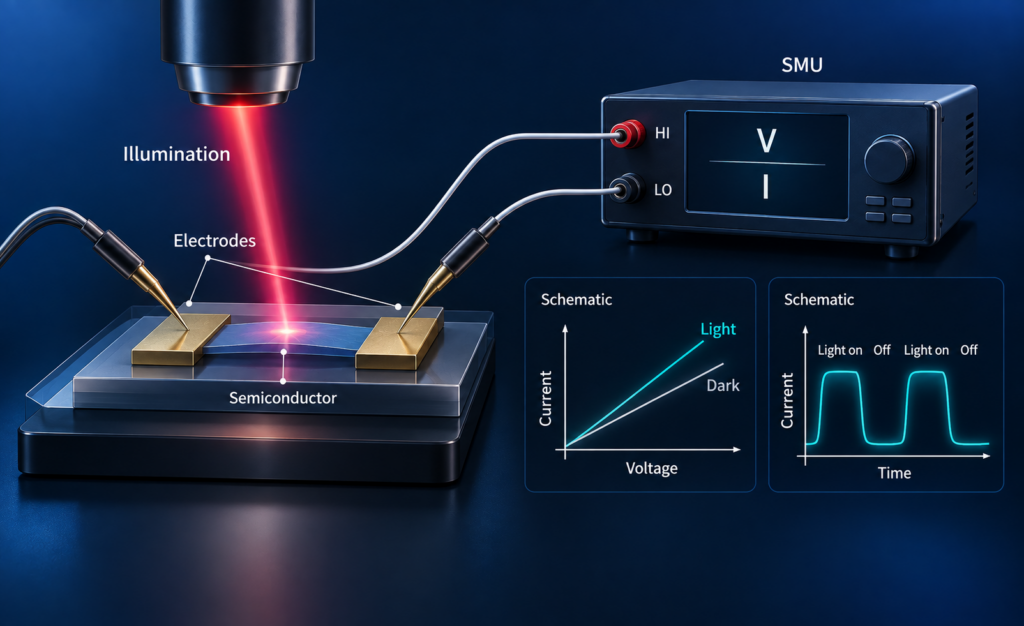
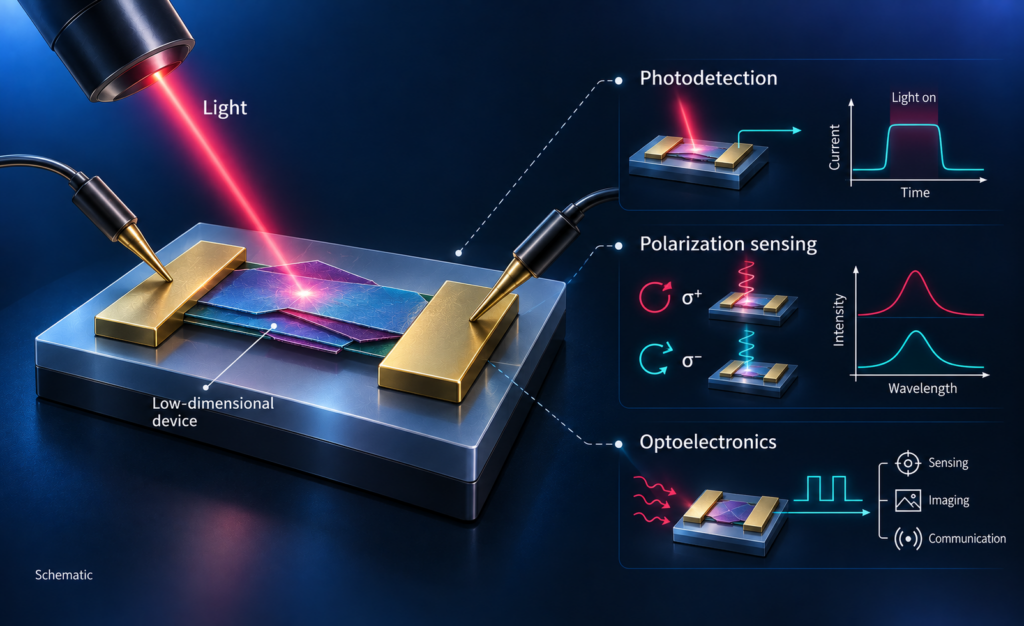
We develop and characterize optoelectronic devices based on low-dimensional materials, focusing on charge transport and photo-induced electrical responses. Our measurements link microscopic symmetry and chirality to macroscopic device performance.

Capabilities
• Electrical transport and I–V characterization
• Photocurrent and photogalvanic effect measurements
• Device fabrication and testing
• Light-matter-coupled transport analysis
integrated measurement platforms

INTEGRATED MEASUREMENT PLATFORMS

We synthesize and characterize nanomaterials and low-dimensional crystals, correlating structural properties with optical and electronic behavior. Structural analysis provides the foundation for understanding chirality, symmetry breaking, and functional device performance.

Capabilities
• Optical microscopy and micro-spectroscopy
• Structural and morphological analysis
• Correlation of structure with optoelectronic properties
• Material preparation for device integration

From Facilities to Research

Our experimental facilities are tightly integrated with our research directions, enabling systematic exploration of chirality, symmetry breaking, and optoelectronic phenomena in low-dimensional quantum materials. Each platform is designed to directly support our core research themes, from fundamental light–matter interactions to functional device applications

Equipment Overview

A curated list of core instruments supporting our experimental research.

Lasers & Light Sources

Continuous-wave diode lasers (UV–NIR)

Supercontinuum light source with wavelength selection

Polarization-controlled excitation modules

Pulsed laser sources for time-resolved spectroscopy

Power-tunable illumination for excitation-density–dependent studies

Spectrometers & Detectors

High-resolution spectrographs for UV–Vis–NIR analysis

Scientific-grade CCD and InGaAs detectors

Polarization-resolved detection optics

Time-resolved photon detection modules

Low-noise signal acquisition systems

Microscopy & Optomechanics

Optical microscopy platforms with custom optical paths

k-space (Fourier-plane) imaging systems

Precision optomechanical stages and alignment modules

Motorized sample positioning and scanning control

Integrated vibration-isolated optical tables

Electrical & Device Measurement Tools

Probe stations for low-dimensional material devices

Source-measure units (SMUs) for transport characterization

Low-noise current and voltage amplification systems

Photocurrent and photoresponse measurement setups

Temperature-dependent electrical transport configurations

Materials Synthesis & Processing

Chemical vapor deposition (CVD) systems for graphene and two-dimensional material growth

Reactive ion etching (RIE) for controlled surface modification and device patterning

Hydrothermal synthesis platforms for graphene quantum dots (GQDs) and nanomaterials

Chemical processing facilities with fume hood infrastructure

Microscope-based 2D transfer systems for heterostructure assembly

Our laboratory integrates material synthesis, microfabrication, and post-processing capabilities to support the full experimental cycle from material preparation to device realization. This platform enables the fabrication of graphene, 2D heterostructures, and nanomaterials, providing precise structural control prior to optical and electrical characterization.

Get Involved with Us

Join a community of dedicated researchers.

Scroll to Top