Symmetry-breaking light–matter interactions in low-dimensional quantum materials
Overview
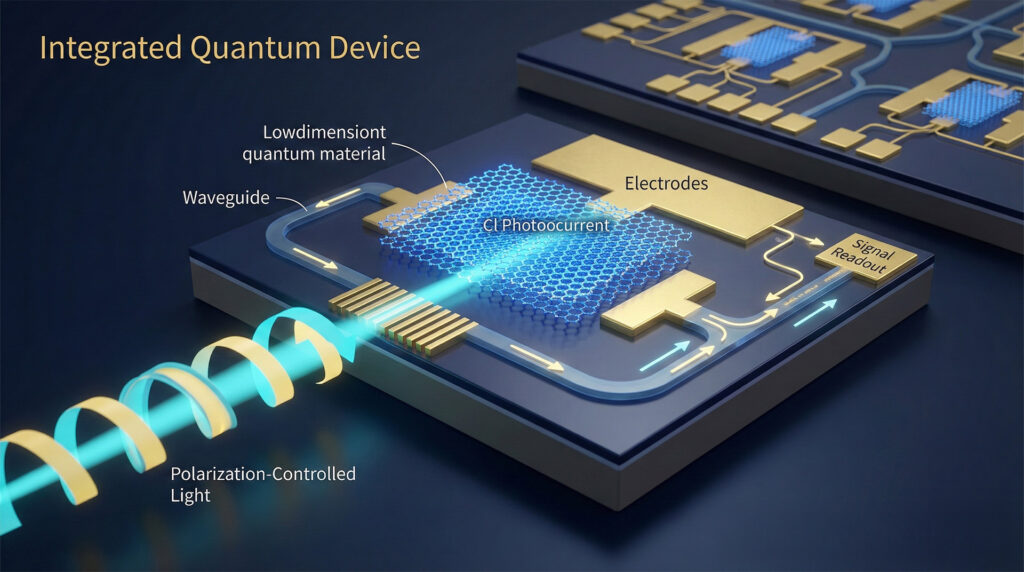
We translate fundamental properties of chiral and quantum materials into functional optoelectronic devices and scalable platforms. By integrating low-dimensional materials into device architectures, we directly link polarization-controlled optical excitation to measurable electrical responses. Our work combines optical spectroscopy, electrical transport, and device engineering to realize polarization-sensitive photodetectors and photonic components. These efforts demonstrate how quantum material physics can be harnessed at the device level. This research aims to establish quantum-ready optoelectronic platforms bridging fundamental science and practical technology.
Scientific Motivation
While quantum and chiral materials exhibit rich physical phenomena, their technological impact depends on successful device integration. Developing functional optoelectronic devices enables direct testing of physical concepts and accelerates translation toward applications. Understanding how symmetry, polarization, and topology manifest in real devices is essential for next-generation photonic and quantum technologies.
Key Research Topics
Polarization-sensitive photodetectors and phototransistors
Device integration of chiral and quantum materials
Optically driven electrical signal generation
Scalable optoelectronic and photonic platforms
Quantum-ready device concepts and architectures
Methods & Experimental Platforms
Fabrication of optoelectronic devices based on low-dimensional materials
Polarization-dependent optical excitation and detection
Electrical transport and photocurrent measurements
Integration of optical spectroscopy with device testing
Photocurrent mapping and electrical transport characterization
Platform-level design for scalable photonic systems
Representative Results
Demonstration of functional polarization-sensitive optoelectronic devices