Symmetry-breaking light–matter interactions in low-dimensional quantum materials
Overview
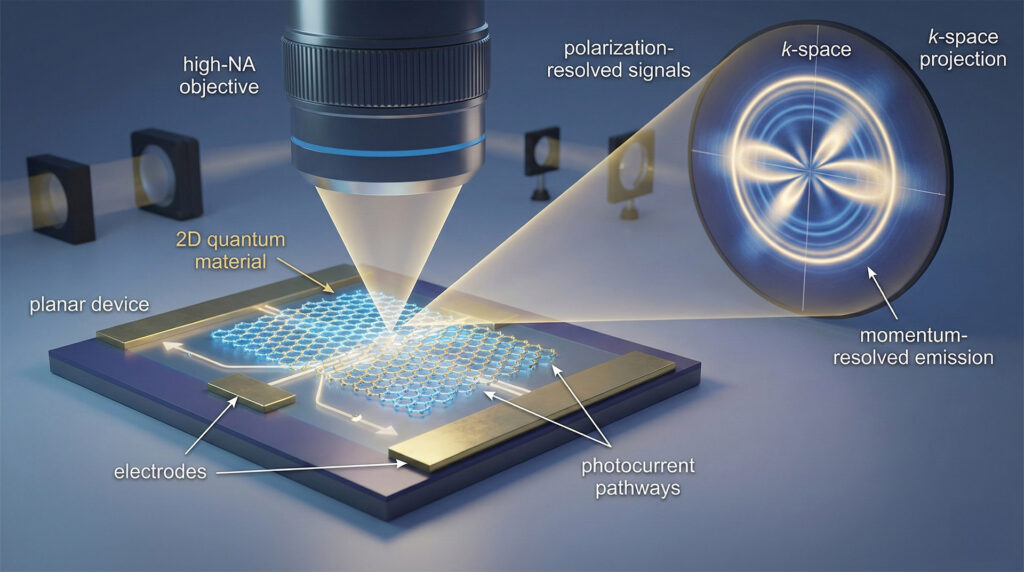
We develop and apply momentum-resolved optical spectroscopy to probe the electronic and excitonic properties of low-dimensional quantum materials and devices. By mapping angular emission patterns and polarization textures using k-space photoluminescence, we directly connect optical responses to band structure and exciton dynamics. These optical measurements are integrated with electrical transport and photocurrent mapping to establish correlations between reciprocal-space information and device performance. Our approach enables a comprehensive understanding of light–matter interaction beyond real-space measurements. This research provides advanced characterization platforms for functional optoelectronic materials and devices.
Scientific Motivation
Many key properties of quantum materials are encoded in momentum space rather than real space. Conventional optical measurements often overlook this information, limiting insight into band structure, valley physics, and exciton dispersion. Momentum-resolved spectroscopy offers a direct route to uncover these hidden degrees of freedom and link them to measurable device responses
Key Research Topics
k-space photoluminescence and angular emission mapping
Polarization textures in momentum space
Exciton dispersion and band-structure-related optical responses
Correlation between k-space optics and device performance
Methods & Experimental Platforms
k-space and back-focal-plane photoluminescence imaging
Polarization-resolved momentum-space spectroscopy
Angle-resolved optical measurements using high-NA microscopy
Confocal microscopy and Raman spectroscopy
Photocurrent mapping and electrical transport characterization
Integration of optical spectroscopy with device platforms
Representative Results
Visualization of momentum-dependent optical emission patterns